Important Note: For Seachem items, they will be collected and ordered from our supplier upon payment. In the event that the item is out of stock, we will promptly contact you and issue a refund for the unavailable item. Thank you for your understanding!
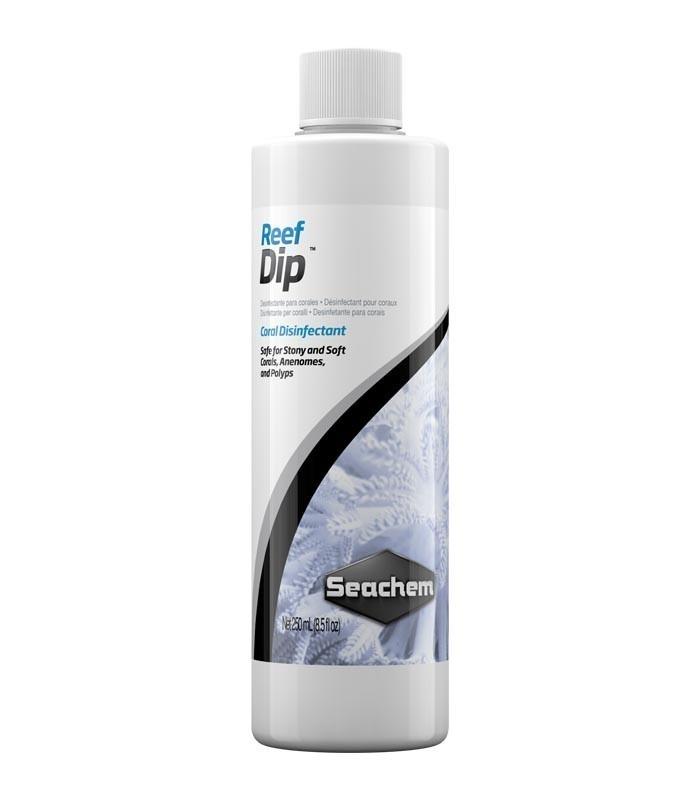
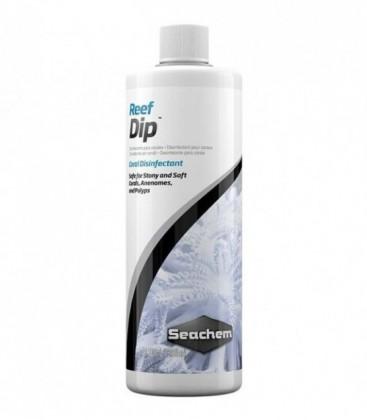
Coral disinfectant
Elemental iodine complex, disinfects corals
Good for use before introducing new corals
Seachem Reef Dip is an iodine solution for disinfecting new corals. This prevents bacteria, fungus and protozoans from being introduced into your aquarium.
Advantages
Reef Dip contains elemental iodine complexed to a protective slime coat for safely and gently disinfecting corals. It is effective against bacteria, fungus, and protozoans. It may be used prophylactically (without evidence of disease) or to remedy diseased specimens. It is safe to use with both stony and soft corals. It is also safe for anemones and polyps.
Reef Dip provides a protective slime coat complex that covers the coral, holding the iodine in contact with the infected site for extended periods of time. In addition, the slime coat prevents infection from re-entering the site.
Directions
Do not use in the aquarium. Use in a separate container. Remove 4 L (1 US gallon) of water from the source aquarium to a container suitable for dipping. Add 5-10 mL (1-2 capfuls) of Reef Dip and mix. Place coral specimen in dip for 15-30 minutes, depending on severity of problem. In very severe cases, a double dose may be used. With clear and accessible lesions, dip concentrate may be painted on lesions directly before placing in dip. Observe animals during treatment for evidence of adverse reactions such as excessive sliming.
FAQ
Can Reef Dip be used when there is a coral crab and/or shrimp on the acropora? I would like to use this dip but I have them on my acroporas.
A: No, I would not use this dip with the crabs/shrimps in your acropora. Remove them or shake them off before dipping.
Does Reef Dip protect against hydroids? My plan was to dip my live rock, corals, and macro algae before putting into the aquarium to try to kill any lurking hydroids.
A: First of all I have heard many different opinions about using live rock with dwarfs due to hydroids (this is a very broad description, the cnidarians include thousands of species). You may want to consider using “dead” rock and a little time to start your own biological system naturally. Reef dip would not be an effective practice in this situation. It is used mainly to combat bacterial and protozoa infections.
I would definitely err on the side of caution and wouldn’t introduce anything else to the system that might pose a threat. If you still want to add macro algae and I would be sure to rinse very well and inspect new specimens, very carefully. Please keep in mind that this is not a guarantee to rid hydroids because even after many precautions hyrdoids can still infect a tank.
Is it safe to use Reef Dip with Tridacna Clams as a preventative?
A: Reef Dip is intended for corals and anemones. We do not recommend it for clams. However, if you feel your clam is diseased, you can try dipping it in a very dilute Reef Dip solution at your own risk. This is not a common practice but I have heard of it being done.
Is there a dip that can help to recover my acropora species?
A: The disinfectant properties of Reef Dip will definitely help these corals by killing any infectious bacteria or protozoan that may be infecting them. Bleaching can also be caused by warm temperature. If this is the case, the only way to correct that is to find a way to cool your water (like a chiller).
Reviews
There are no reviews yet.