Shop
$15.90
Share on
We do provide express shipping(Within 1-2 Business Days)
Animals are healthy, active and feeding on commercial pellets.
Items are tested before being shipped to you.
We can be reached at 6530 3606 during Business Hours.
Important Note: For Seachem items, they will be collected and ordered from our supplier upon payment. In the event that the item is out of stock, we will promptly contact you and issue a refund for the unavailable item. Thank you for your understanding!
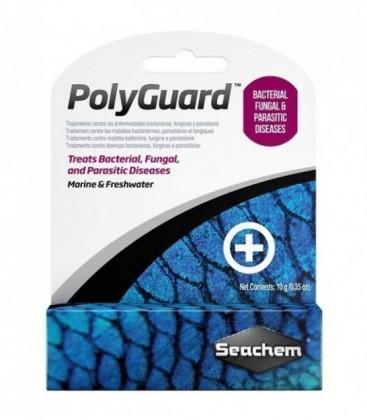
Treats bacterial, fungal, and parasitic diseases
Very broad spectrum freshwater medication
Good choice when unsure of the disease
PolyGuard is a powerful anti-bacterial antibiotic medication that treats all prevalent bacterial, fungal, and parasitic diseases in freshwater or marine fish.
PolyGuard is among the strongest of Seachem medications, and is best used when you are unsure what disease you are treating or when the fish is suffering from multiple infections.
For use in freshwater or marine aquaria.
Ingredients
Active ingredients: sulfathiazole (36%), malachite green (1.9%), nitrofurantoin (0.14%), nitrofural (0.14%), quinacrine dihydrochloride (0.27%). Inactive ingredients: excipients (61%)
Indications
PolyGuard is appropriate for treating a variety of bacterial, fungal, and parasitic diseases of exotic fish. Below are some of the more common diseases treatable with PolyGuard. Be aware that many diseases and infections share similar physical and behavioral symptoms, e.g. clamped fins, lesions, loss of appetite.
Fin Rot
Bacterial infection: Fins appear shredded, frayed, or decaying. Fin Rot is frequently mistaken for damage from fin-nipping fish. Contrary to the name, this is actually caused by bacteria, not fungus.
Suggested Treatment Period: 7 days or until infection clears
Special Considerations: Fin Rot is often found as a secondary infection (that’s an infection that started because the fish was already sick). Make sure to check for additional infections.
Hemorrhagic Septicemia
Aeromonas hydrophilia: Reddish streaks in the fins near the body or under scales. Common in goldfish. Associated with overcrowding and stress, particularly in goldfish and koi. It can also be caused by a virus.
Suggested Treatment Period: 1 week
Special Considerations: This infection is strongly linked to crowding and poor water conditions. Make sure your fish have clean water and plenty of space.
Ich (White Spot)
Ichthyophthirius (freshwater) / Cryptocaryon (saltwater): Looks like salt sprinkled on the fish body and fins. Usually accompanied by twitching, flashing, and other signs of stress and irritation. Several parasites are grouped under this name, but the symptoms are almost identical. Ich is among the most common infections of fish, and is entirely treatable with diligence and attention to water quality.
Suggested Treatment Period: 14 days
Special Considerations: It is very important with this parasite to continue dosing for the full treatment period. A break in the medication allows the parasite to multiply and reinfect the fish.
Mouth Rot
Columnaris: Damaged fins, ulcers and yellowish patches on gills, tissue on head and mouth eaten away. This infection appears gruesome, but is entirely treatable. It is common to see fungus-like tufts around the face and mouth in addition to deterioration of tissue. It is essential to catch this disease early to prevent long-term damage.
Suggested Treatment Period: 1 week
Special Considerations: Columnaris is very contagious. If possible, remove the infected fish to treat separately in a hospital tank.
Fungus
Symptoms: Cotton-like tufts of white fiber. Almost always a secondary infection (appears when fish is already infected with a disease). True fungal infections, while unsightly, generally do not pose an immediate danger to fish.
Suggested Treatment Period: 1 week or until fungus clears
Special Considerations: Fungus is relatively easy to treat and almost never fatal on its own. However, it tends to appear as a secondary infection, meaning there is a more serious disease causing the fish to be susceptible to a fungus.
Directions
Before Treating: Remove all invertebrates – these are extremely sensitive to medication. Turn off UV filters, ozone filters, and remove chemical filtration like MatrixCarbon and Purigen. Ensure that your tank is fully cycled and stable; poor water quality is the root cause of most fish diseases, and adding medication will do no good if the water chemistry is still bad.
Dosing: Use 1 measure (included) per every 40 L (10 US gallons) of water. Repeat this dose every 72 hours for a maximum of 2 weeks. Repeat every 3 days for up to 2 weeks or until symptoms disappear. Use whenever introducing new fish.
After Treating: When the treatment period is over, PolyGuard can easily be removed using activated filter carbon like MatrixCarbon. It does not linger in the substrate or filter media of the tank.
FAQ
Most medications I have used require a daily dosage. Your directions, “repeat every 3 days for up to 2 weeks.” My understanding is to skip 2 days between dosages for a total of 4 doses in 2 weeks. Is this correct?
A: You are correct on the dosage of PolyGuard.
Is it safe to continue to use Melafix while administering PolyGuard?
A: As a general rule of thumb, I would not mix medications. If you feel you must, please watch your fish closely. Water exchanges should be performed after the complete 2 week dosage (4 total doses) before continuing with anther 2 week dosing of PolyGuard.
How does PolyGuard compare with ParaGuard?
A: PolyGuard is different from ParaGuard in the fact that PolyGuard contains antibiotics and ParaGuard acts more like a disinfectant/antiseptic and does not contain antibiotics.
Reviews
There are no reviews yet.