
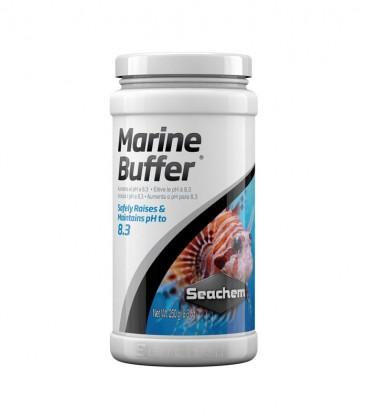
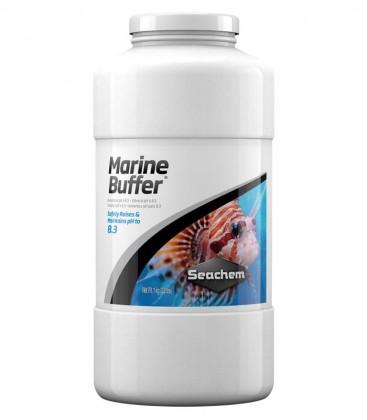
Description
Important Note: For Seachem items, they will be collected and ordered from our supplier upon payment. In the event that the item is out of stock, we will promptly contact you and issue a refund for the unavailable item. Thank you for your understanding!
Raises and maintains pH at 8.3 in all saltwater aquarium
Safe for reef tanks
Contains borate for added stability
Contains magnesium to alleviate precipitation effects
Marine Buffer raises and maintains water pH at 8.3. Marine Buffer is safe for dosing marine tank because there is no danger that the water pH would rise beyond 8.3 even if inadvertently overdosed. Marine Buffer is a blended product that keeps the water at a maximum of pH 8.3.
Alternative products use sodium bicarbonate or sodium carbonate. These also raise water pH but if not dosed carefully, there is a danger that the pH may rise to dangerous levels.
Benefits of Seachem Marine Buffer
Raises water pH for marine aquarium
pH stays at 8.3
Safe for reef tanks
Contains borate for added stability
Contains magnesium to alleviate precipitation effects
How Marine Buffer Works
Marine Buffer contains sodium, magnesium, calcium, strontium, and potassium salts of carbonate, bicarbonate, chloride, sulfate, and borate.
Use Seachem MultiTest Marine pH & Alkalinity to check pH and total alkalinity.
Use Marine Trace to restore the proper level of trace and feed NutriDiet Marine Flakes for thriving, healthy saltwater fish.
Total Alkalinity is a measurement of three main ions: carbonate, bicarbonate, and borate. In saltwater, bicarbonate drives the pH toward 7.8, carbonate drives pH toward 9.1, and borate toward 9.5 or more. Because of the chemistry of buffering systems, the closer you get the pH to the pK of a buffering system, the harder it is for the pH to shift. So, if you blend a buffer so that the combined product drives the pH toward 8.3, then the more you use, the more stable the pH becomes. That is the principle behind Marine Buffer.
Seachem Marine Buffer is a blended buffer that drives and holds your pH at 8.3 because of the blend. The catch to this seemingly simple solution is that most salt mixes contain substantial amounts of bicarbonate salts. This shifts the pK of the buffering system further towards 7.8, and a buffer that shoots for 8.3 will never quite get there. Thus, the pK of Marine Buffer is actually slightly higher than 8.3 in order to combat the influx of bicarbonate at every water change. Marine Buffer was the first buffer on the market which contained borate salts (which make a saltwater buffering system much more stable), and Marine Buffer remains the most effective pH buffer on the market for marine aquaria.
Directions
Add 5 g (1 level teaspoon) for each 80 L (20 US gallons). For precise dosing, use the Seachem Digital Spoon Scale. Dissolve in at least one cup of freshwater. This dose will also raise alkalinity by about 1 meq/L. Add daily until pH stabilises at 8.3. This will take from a day to a week, depending on original pH and alkalinity. Thereafter, use biweekly or monthly to maintain a pH of 8.3.
If this practice is not adequate, then overstocking, overfeeding, or other poor management practice should be sought as a likely cause. In ionically balanced marine water, Marine Buffer produces little precipitate or cloudiness. If an extensive precipitate forms upon addition of Marine Buffer that does not dissolve within ~15 minutes, then poor ionic balance was present. A water change should be initiated when convenient before further use of the product. Effectiveness improves with continued use. Do not directly mix with any calcium, magnesium, or strontium supplement.
FAQ
What is the difference between the Reef Buffer and the Marine Buffer?
A: Marine Buffer has a pK of 8.3. PK is a number that represents the pH of a buffer. Reef Buffer has a heavier carbonate influence than Marine Buffer giving it a higher pK. Because of this, Reef Buffer is more successful at overcoming acids where intense biological activity occurs resulting in heavier acid production like in a typical reef aquarium.
When I added Marine Buffer to my tank I got a very light, white, fluffy precipitate, what should I do?
A: This is a temporary magnesium carbonate precipitate. No need to worry, it will redissolve in half an hour or so. Sometimes this can form if your magnesium is on the high side.
I have a freshwater planted tank. I’ve been using Acid Buffer to lower pH. According to the label I should use Alkaline Buffer as well to target a pH. Can I use Marine Buffer instead? And if so, at what dosage?
A: I would not use Marine Buffer in this situation as the ingredients are different than what is used in Alkaline Buffer and is designed to achieve a pH of 8.3. The ratios on the labels of Acid Buffer and Alkaline Buffer are designed to create a buffering system and target a set pH in a water that does not have any buffering ability (no acids and/or bases present). In an established aquarium, this is generally not the case. I would only use Acid Buffer to lower pH and KH or use Alkaline Buffer to raise pH and KH.


Reviews
There are no reviews yet.