Important Note: For Seachem items, they will be collected and ordered from our supplier upon payment. In the event that the item is out of stock, we will promptly contact you and issue a refund for the unavailable item. Thank you for your understanding!
Raises carbonate alkalinity (KH) with minimal impact on pH
A blend of carbonate sources that will not lower pH as competing bicarbonate only products can
Will not deplete calcium, magnesium, or strontium
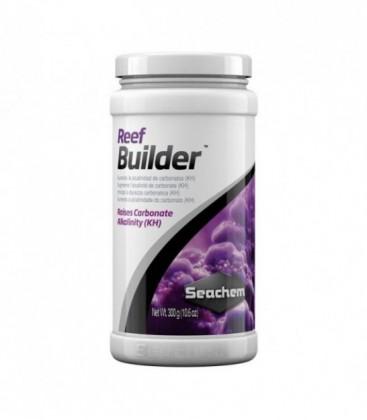
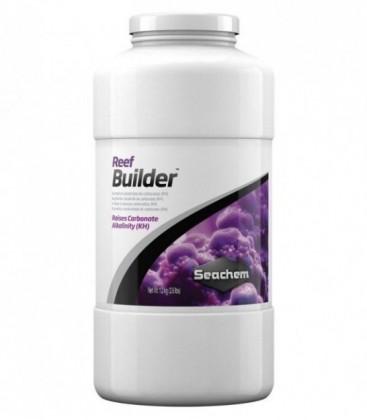
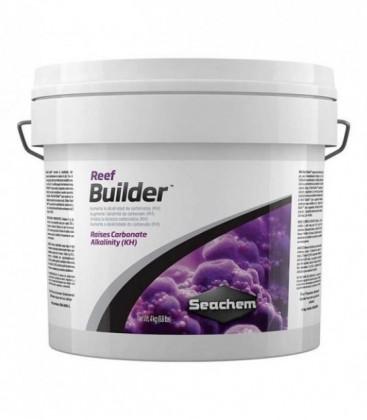
Reef Builder raises carbonate alkalinity (KH), stabilises water at pH 8.3 optimal for marine and reef aquarium. Reef Builder will not deplete calcium, magnesium or strontium.
Advantages
Reef Builder raises carbonate alkalinity (KH) without immediately impacting on pH. With long term use there will be a tendency to stabilise at pH 8.3. Used as directed, Reef Builder will not deplete calcium, magnesium, or strontium which usually tend to precipitate with increasing alkalinity.
Reef Builder and Reef Buffer may be used together.
Use Reef Builder to raise carbonate alkalinity without affecting pH.
Use Reef Buffer to raise carbonate alkalinity and pH. Reef alkalinity should be maintained at 3-5 meq/L (8-14 dKH). Alkalinity should not be allowed to fall below 2 meq/L.
Directions
Beginner:
Use 3 g (1/2 level teaspoon) per 150 L (40 US gallons) twice a week. Dissolve in at least 250 mL (1 cup) of freshwater. Check alkalinity every 2 weeks and adjust amount or frequency accordingly. For precise dosing, use the Seachem Digital Spoon Scale.
Advanced:
Check alkalinity (use MultiTest Marine pH & Alkalinity to test alkalinity levels), then follow addition regimen above until alkalinity is adjusted to 3-6 meq/L (8-17 dKH). Each 3 g/150 L will raise alkalinity by about 0.25 meq/L. Quantity or frequency can be adjusted, but do not exceed 12 g/150 L per day. Thereafter, use as required to maintain alkalinity.
Expert:
After determining the alkalinity consumption rate, set up a continuous drip system. Use the following formula (or skip the math and use our Dosage Calculator) to determine how much to add to your top-off water: m=0.08va (m=grams to add to top off water, v=volume of tank in litres, a=amount to raise alkalinity in meq/L). For example, if you want to raise your alkalinity by 1 meq/L in a 200 litre tank, then you would add 0.08x200x1=16 g into the top-off water. [For reference: 1 gallon=3.8 litres, 6 g=1 teaspoon].
DO NOT OVERDOSE: Excess alkalinity may enhance the loss of calcium, magnesium, and strontium. Do not directly mix with any calcium, magnesium, or strontium supplement. Best if calcium & carbonate additives are added on alternate days or at least 30 minutes apart.
FAQ
What is the difference between Reef Builder and Reef Buffer?
A: While both products affect pH and alkalinity, Reef Buffer’s primary function is affecting pH, while Reef Builder’s primary function is affecting alkalinity. When pH is the primary concern, use Reef Buffer. When pH is not an issue, use Reef Builder to adjust alkalinity.
When I dissolve Reef Builder at the prescribed 4 tspn per gallon in RO water the resulting solution is cloudy and does not clear upon standing. Also sometimes I find some of the material is very stubborn to dissolve. Is this normal?
A: When dissolving at the prescribed concentrations it is normal for the solution to be somewhat cloudy. Add Reef Builder to your RO water, and stir it for a few minutes or let it stand about 10 minutes, then add it to your tank. It will dissolve rapidly at this point. Pre-dissolving Reef Builder is recommended mainly as a more gentle delivery method (as opposed to just putting the dry product directly in the tank) not as something you would dose with (in which case you would want it all dissolved). It is also normal for small amounts of the material to not be dissolved if you let the RO or DI water and Reef Builder solution sit overnight… small amounts of calcium carbonate can form sometimes within the bottle, and it is this material (chalk) which is very insoluble. It will eventually dissolve in the tank however since the amounts are very small and the volume of the tank is many times greater than the 1 gallon of RO or DI water.



Reviews
There are no reviews yet.